
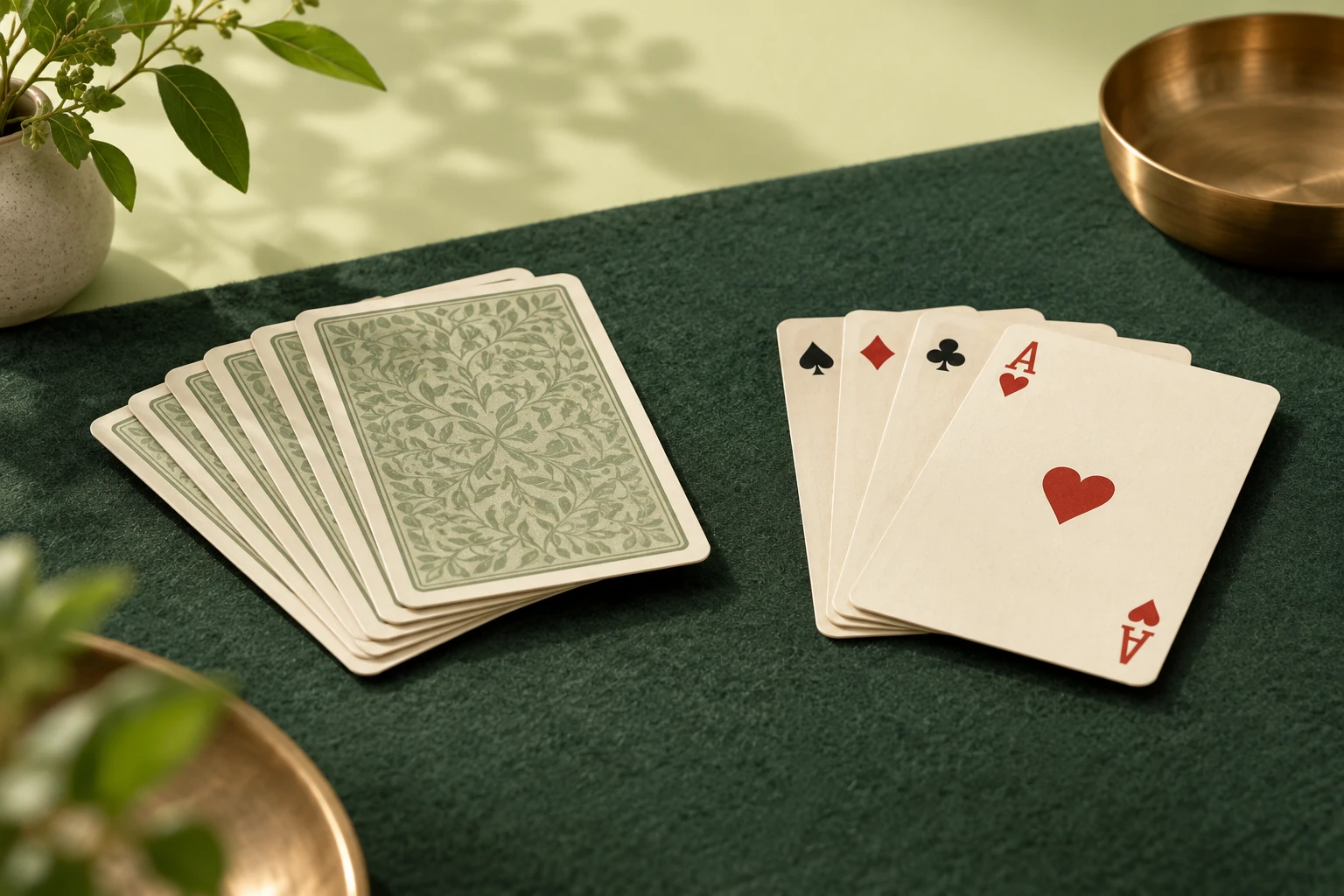
Rummy is one of the Indian card formats listed in the published Batery description, alongside Teen Patti and Andar Bahar. The three use the same pack and similar card names but ask the reader to do quite different things. Rummy asks you to group cards; Teen Patti compares hands; Andar Bahar traces a matching-card reveal. This page handles Rummy only, and it stays with the parts that a beginner can check against a real rule sheet.
Batery here means the brand named in the description supplied to this publication. This site is independent, and account creation, login and payment are not connected.
Name the cards before grouping them
Every card carries two facts: a rank and a suit. In 6♥ the rank is six and the suit is hearts. Written out this way, the information is easy to check; a small symbol on a dim screen is not. Two cards, 6♥ and 6♣, share a rank and differ in suit, and that difference matters more in Rummy than in many other card games because the suits usually decide whether a group is permitted at all.
Before grouping anything, note what the rule sheet says about the pack and the hand. How many cards are dealt, whether a joker is printed or assigned, and how the hand should end are all settings the rules decide. A picture of three neat cards establishes none of them.
Compare a sequence with a set
A simple illustration makes the difference clear. The cards 5♥, 6♥ and 7♥ run in order within one suit. The cards 9♣, 9♦ and 9♠ share a rank and spread across suits. The first is usually called a sequence and the second a set, and the arrangement is visible at a glance.
Ordering alone is not enough for a sequence. The made-up group 4♥, 5♣, 6♥ is in order but mixes suits, so it is not a same-suit run and would not normally count as a sequence. Keep this example beside the real ones when you read a rules section: it shows that consecutive numbers without a shared suit tell only half the story.
Bicycle’s published Rummy rules describe matched groups of equal ranks and same-suit runs across the family of Rummy games. That description is the general shape of the game; it is not an Indian Rummy deal, and Bicycle sets out its own player numbers, dealing and scoring that differ between variants. Treat its layout as one version and read the version in front of you for the figures.
Keep joker definitions beside the example
A printed joker and a card given a wild rank may not do the same job. Some versions also separate a natural or pure sequence, one built without any substitution, from a group that uses help.
Return to the run 5♥, 6♥, 7♥ and imagine the middle card swapped for a joker. The drawing now throws up a rules question rather than an answer: does a substitution hold up in the position you are checking, and does it affect the pure-sequence condition? Only the version’s own wording settles it, so copy that definition next to the diagram instead of judging by eye.
A complete hand needs a complete explanation
One valid group does not make a finished hand. Check the full set of required groups, what happens to the cards left over, and how the hand ends and is scored. Write the variant’s name and any points rule beside the diagram, because a declaration that satisfies one rule sheet can fail another.
Keep notes in ordinary card notation. A plain line such as “these three cards share a rank” can be checked against the rules, whereas “this is a strong hand” cannot. Learning the labels helps you read and discuss the game; it does not forecast a result.
Read the other card categories separately
Teen Patti settles by comparing hands, and Andar Bahar follows a round of matching reveals; neither uses Rummy’s grouping task. Our Batery Indian card-game guide explains those two formats on their own terms and keeps their vocabulary apart from sequences and sets.
For how this publication treats sources and illustrations, see the editorial policy. The card examples on this page can be studied with a real deck and a sheet of paper, and they need no stake to follow.
Sources
Card notation is standard. The general description of Rummy groups is paraphrased from Bicycle Cards’ Rummy page, which describes the Rummy family and its own variants. The position of Rummy among the Indian card formats comes from the published Batery brand description supplied to this publication. Examples are original explanatory illustrations, not screenshots or records of any product.