
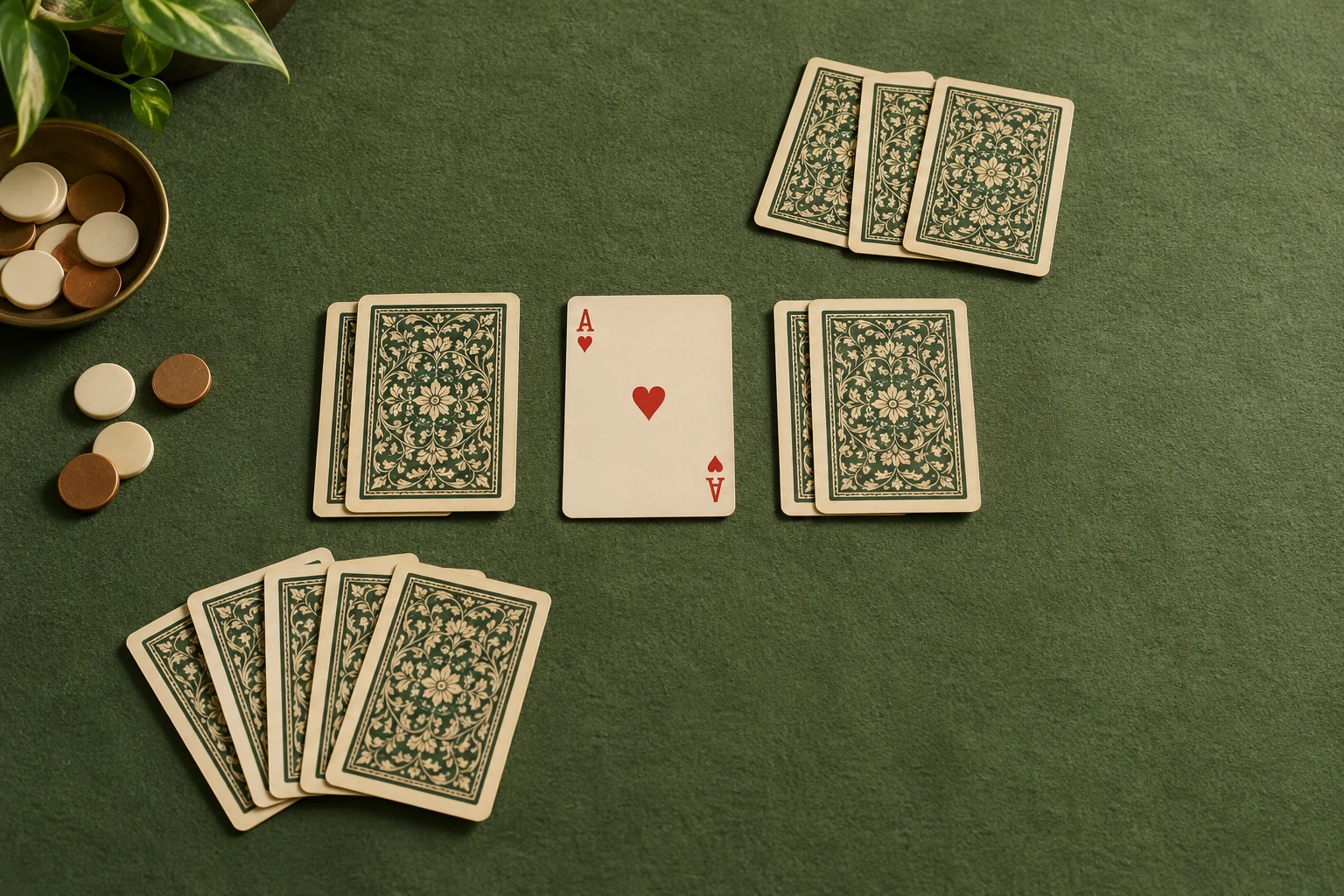
Three cards laid beside a reference card can tell several different stories. You might be comparing a hand, following a matching-card round or grouping a Rummy sequence. Identify the game before naming what the cards demonstrate.
This Batery India card-game guide focuses on Teen Patti, Andar Bahar and Rummy. It explains their different reading tasks and identifies external references. Check the rules of the specific version before playing.
Teen Patti compares the cards in a hand
Read the named version’s hand-ranking table and tie rules before comparing examples. Record the actual ranks and suits. Three cards of the same suit and three equal ranks describe different patterns, even when both pictures look coordinated.
Evolution’s Teen Patti page describes its own three-card version against a dealer. Its separate optional-feature rules belong to that version. They should not be assumed for every game labelled Teen Patti.
Andar Bahar follows a matching-card round
Keep the reference card separate from the two named sides. The useful reading task is to follow the dealt order and identify the matching rank under the named rules. Record which side receives each card rather than relying on its position in a cropped image.
For a hypothetical diagram, make the reference rank seven and label the dealt cards in order. A later seven shares the rank even if its suit differs. The diagram still needs an explicit starting-side assumption and a complete rule sheet before it describes a particular version.
Rummy organises cards into groups
The Batery Rummy guide explains the common distinction between same-suit consecutive ranks and equal-rank sets. It also keeps joker conditions and complete-hand requirements tied to the exact variant.
Try writing the cards in full when symbols are unclear: five of hearts, six of hearts, seven of hearts. This makes the suit pattern easy to check. A group illustration does not establish a complete declaration.
Keep source labels with the catalogue cards
The 100 Teen Patti reference and Andar Bahar reference lead to Jackpotter catalogue pages. Those labels identify external sources. A catalogue page may change or become unavailable, so check the live destination before relying on its details.
PlayWSOP supplies a separate poker reference. Its site describes virtual-chip play for adults aged 21 and over. Keep poker’s own named rules separate from the Indian card categories discussed here.
Use one complete example at a time
Place the game name, variant and relevant rule beside each card diagram. Explain what the example establishes and which conditions remain unspecified. The live-table guide adds table names and round records when those details are relevant.
These educational comparisons can be read with ordinary cards and paper. For this publication’s source and illustration standards, see the editorial policy.
Game collection
Examples from their named catalogues; availability at any operator has not been verified.
100 Teen Patti

A three-card table-game title listed in the supplied game catalogue.
Source: Jackpotter game catalogue.
Andar Bahar

A matching-card game reference; check the rules of the named version.
Source: Jackpotter game catalogue.
Texas Hold’em

A social-poker reference from PlayWSOP using virtual chips, for ages 21 and over.
Source: PlayWSOP game catalogue.
Caribbean Poker

A Caribbean Poker game reference listed by Jackpotter.
Source: Jackpotter game catalogue.