
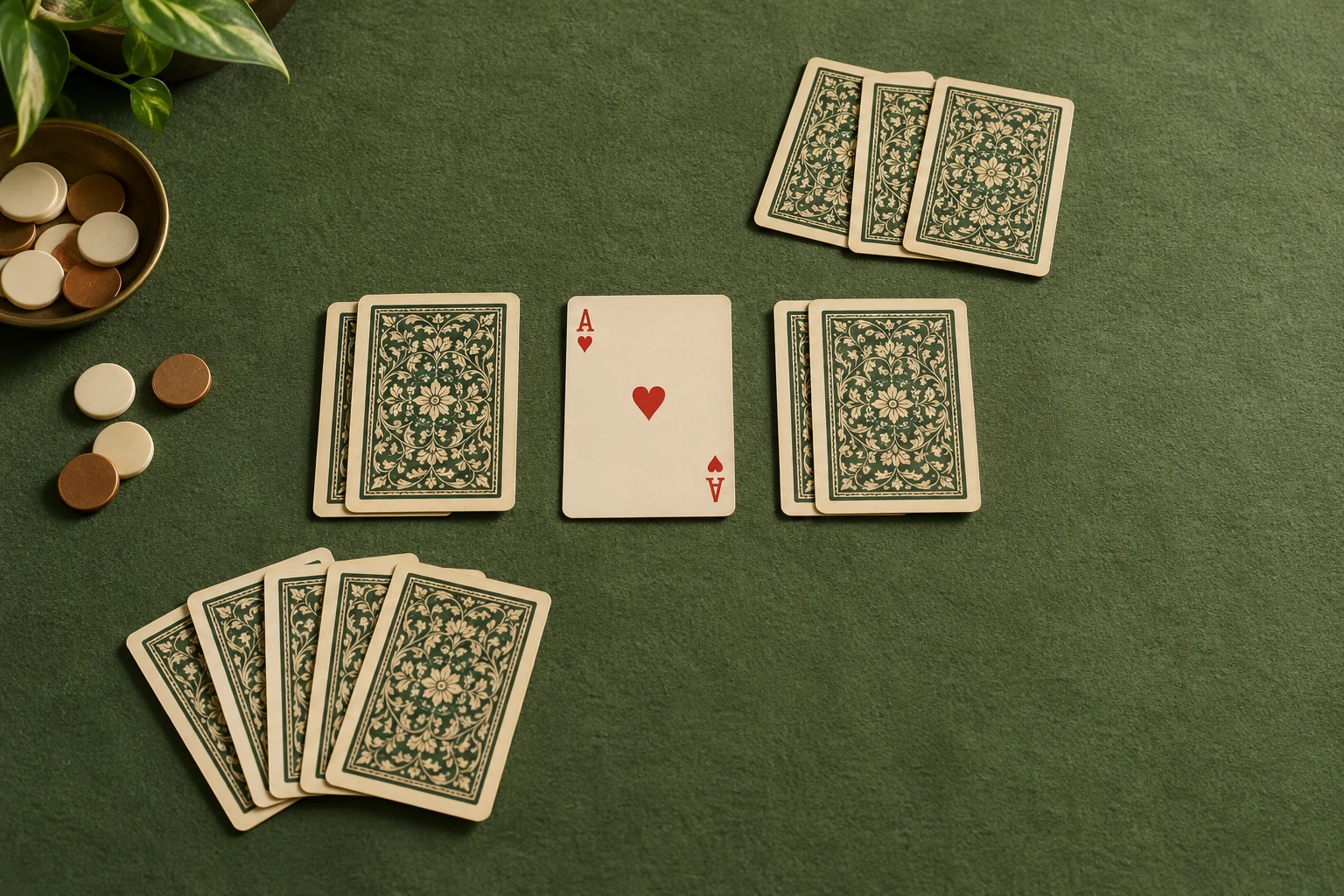
Batery casino coverage brings together three distinct card-game styles: Teen Patti, Andar Bahar and Rummy. Each has its own rhythm, from comparing three-card hands to matching a rank or building groups of cards.
These game examples and their sources offer a closer look at each format. Rules and availability depend on the specific provider and version.
Teen Patti: Three-Card Hands
Read the named version’s hand-ranking table and tie rules before comparing examples. Record the actual ranks and suits. Three cards of the same suit and three equal ranks describe different patterns, even when both pictures look coordinated.
Evolution’s Teen Patti page describes its own three-card version against a dealer. Its separate optional-feature rules belong to that version. They should not be assumed for every game labelled Teen Patti.
Andar Bahar: Matching Cards
Keep the reference card separate from the two named sides. The useful reading task is to follow the dealt order and identify the matching rank under the named rules. Record which side receives each card rather than relying on its position in a cropped image.
For a hypothetical diagram, make the reference rank seven and label the dealt cards in order. A later seven shares the rank even if its suit differs. The diagram still needs an explicit starting-side assumption and a complete rule sheet before it describes a particular version.
Rummy: Sequences and Sets
The Batery Rummy guide explains the common distinction between same-suit consecutive ranks and equal-rank sets. It also keeps joker conditions and complete-hand requirements tied to the exact variant.
Try writing the cards in full when symbols are unclear: five of hearts, six of hearts, seven of hearts. This makes the suit pattern easy to check. A group illustration does not establish a complete declaration.
Card-Game Catalogue Highlights
The 100 Teen Patti reference and Andar Bahar reference lead to Jackpotter catalogue pages. Those labels identify external sources. A catalogue page may change or become unavailable, so check the live destination before relying on its details.
PlayWSOP supplies a separate poker reference. Its site describes virtual-chip play for adults aged 21 and over. Keep poker’s own named rules separate from the Indian card categories discussed here.
Different Games, Different Formats
Place the game name, variant and relevant rule beside each card diagram. Explain what the example establishes and which conditions remain unspecified. The live-table guide adds table names and round records when those details are relevant.
These educational comparisons can be read with ordinary cards and paper. For this publication’s source and illustration standards, see the editorial policy.