
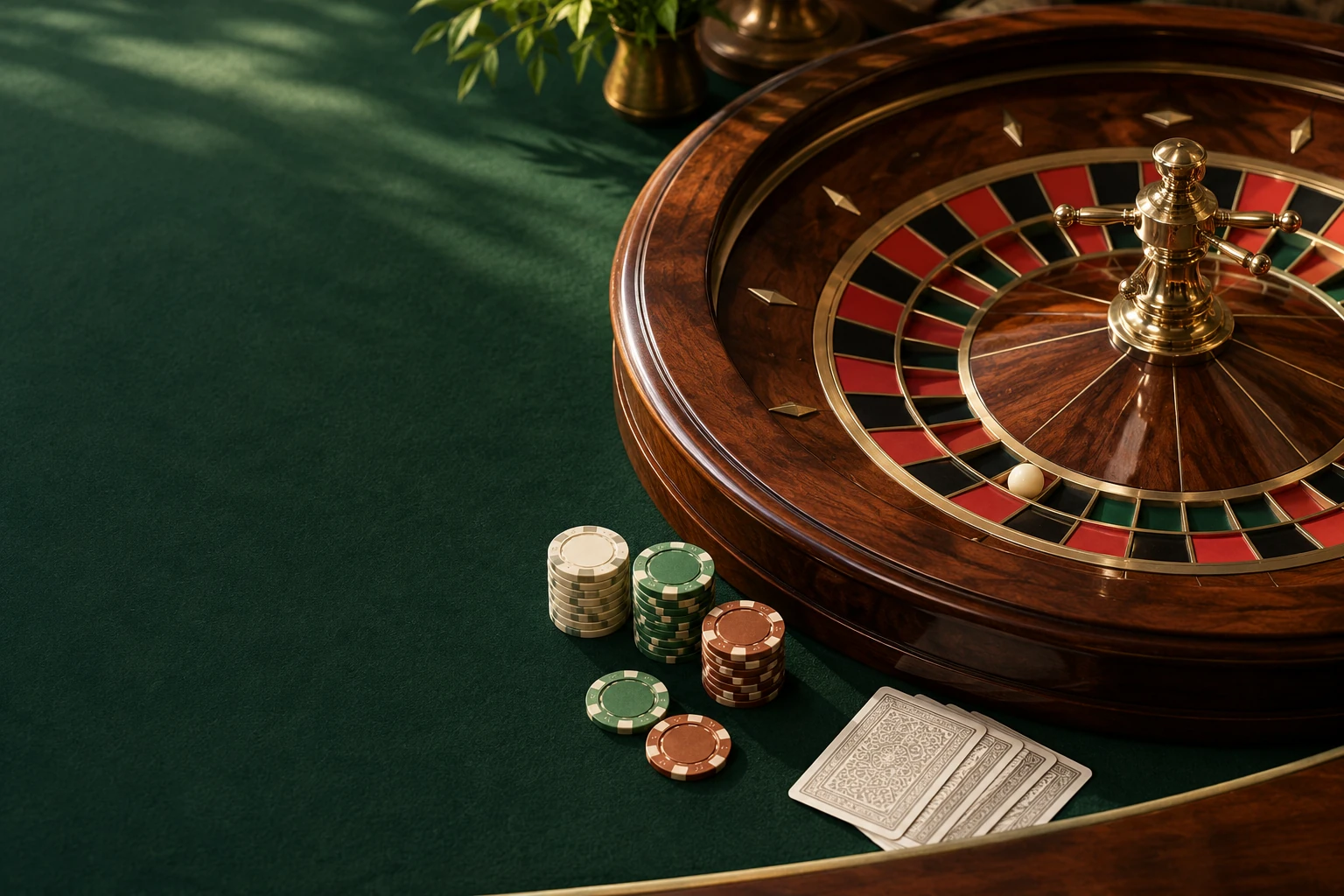
Live casino tables bring together familiar formats such as blackjack, roulette and baccarat. Each has a distinct layout and rhythm, whether a round centres on a hand of cards, a spinning wheel or two competing hands. Rules and features vary by table and provider.
Blackjack: Cards and Hand Values
Number cards count at face value. Picture cards count ten. An ace counts eleven or one, and you take whichever suits the hand. A total that still includes an ace counted as eleven is called soft; once the ace has to drop to one, the hand is hard. Ace plus six is soft seventeen. If a nine arrives, the ace falls to one and the total becomes sixteen hard. It does not become twenty-six. Any hand above twenty-one busts and loses before the dealer acts.
A natural, or blackjack, is an ace with a ten-value card in the first two cards. A three-card twenty-one is an ordinary twenty-one and is not paid as a natural under standard rules. The four choices on a hand are hit (take another card), stand (take no more), double (increase the wager once and receive exactly one more card) and split (turn a pair into two separate hands, each with its own wager). Insurance, where a table offers it, is a separate side wager on the dealer having a natural, and is not part of the main hand.
Dealer play is governed by the table rule. Many tables require the dealer to stand on all seventeens; others require a hit on soft seventeen. Whether doubling is allowed on any two cards or only on certain totals, and how many times a pair may be split, also differs. Read those lines on the rule sheet before placing a bet.
Blackjack Table Variations
A clear worked hand. You hold a ten and a seven: seventeen, hard, and you stand. The dealer shows a nine and turns over a seven, giving sixteen. The dealer must draw. The next card is an eight, so the dealer’s total is twenty-four and the hand busts. Your seventeen wins.
The same picture applies to the soft-ace case, used here only to show how a total changes. You hold ace and six, soft seventeen, and choose to hit. A nine arrives, the ace becomes one, and you now hold sixteen hard. From there a further card could bust you. These examples show arithmetic and decision order. They are not results from any table, and they say nothing about what a future hand will do.
Roulette: The Wheel and the Layout
The layout puts the numbers in a grid with the zero, or zeros, at the top. Inside bets cover a single number or a small group such as a split or a street. Outside bets cover red or black, odd or even, high or low, and the dozens and columns, each covering a larger block of numbers.
Zero is neither red nor black and belongs to no parity or high-low group. In standard roulette, an even-money outside bet loses when the ball settles on zero. That is the common case, not a universal one: some specifically named rule sets, such as la partage or en prison, treat certain outside bets differently when zero appears, for example by returning half the stake or holding it over. Settlements therefore depend on the version, and the table’s rule sheet is the place to confirm it. Whether the wheel carries one zero or two belongs to the table description as well, and the two layouts are not interchangeable.
Each spin is independent. Suppose red has come up five times running. On a single-zero wheel the chance of red on the next spin is unchanged, because the wheel has no memory of the previous spins. Read a streamed spin once the ball has settled and the result has posted. The position of your chips before that is not the result.
Baccarat: Player and Banker Hands
Baccarat compares two hands, Player and Banker, with Tie as a third possible outcome. The words Player and Banker name the hands, not people. Face cards and tens count zero, aces count one, and the remaining cards count at face value. Totals are read modulo ten, so a hand of seven and eight makes fifteen, which reads as five. Nine and seven would make sixteen and read as six. A two-card total of eight or nine is a natural and both sides stand.
The third card is not a judgement call; it follows the drawing rules. On the Player side, a two-card total of nought to five draws a card, and six or seven stands. The Banker side then follows its own table, which depends on the Banker total and, when the Player drew, on the value of the Player’s third card. Because the Banker’s rule table differs by total, it must be read from the sheet rather than guessed. Commission on Banker wins, where a table applies one, is also stated there, and this article assigns no rate to any table.

Live-Table Catalogue Highlights
When a table carries a variant name, treat it as its own game. Altered payouts, multipliers, side wagers and extra rounds belong to that variant, and their mechanics are not assumed here without a supplier document.
Four entries below are attributed external catalogue references, read from Jackpotter’s individual pages. They are labels only, not Batery inventory, and nothing here says they are available on Batery. Blackjack (Smartbet), D Roulette (SA Gaming), Baccarat D07 (SA Gaming) and D Sic Bo (SA Gaming). Sic Bo is a three-dice table; its bet types and payouts depend on the version, so no figures are given here. The individual rule sheet for each table remains the only authority on its mechanics.
Live-Table Round Records
A streamed table shows a live dealer inside a browser frame, with a bet area, a countdown and usually a results strip. When betting closes, the deal or spin proceeds. The video feed is continuous, but the record is discrete. Between rounds the picture may still show the last hand, the dealer preparing the shoe, or an animation. Wait until the interface marks the round settled before reading an outcome.
Bet status messages such as accepted, rejected or void are interface vocabulary; they describe the system’s acknowledgement, not the chip on the felt. Each round generally also carries a short identifier near the bet panel or in a history list, useful when two hands look alike. This publication is an independent information site. Account creation, login and payment are not connected here, so these terms are explained as reading aids only.
Live Games at a Glance
| Table | Core object | Reader’s checkpoint |
|---|---|---|
| Blackjack | Hand values and dealer rule | Soft or hard total; natural against three-card 21; dealer rule on seventeen |
| Roulette | Wheel layout and zero count | Inside or outside bet; zero settlement by version; result after the ball settles |
| Baccarat | Modulo-ten totals | Rule sheet for the third card; commission terms, if any |
| Sic Bo | Three dice | Version-specific payouts; not stated here |
Volatility and return-to-player figures describe long-run supplier behaviour and are not session promises. Any such figure must come from supplier documentation, and this article states none. The Indian card tables article covers Teen Patti, Andar Bahar and Rummy; the slots guide covers paytable reading; the Rummy information page sits within that set. Source-attributed offer terms, marked unconfirmed, are collected on the offers information page, and general points are on the FAQ.
Sources
- Brand description reference
- Evolution live blackjack page (ordinary values and decisions only)
- Evolution baccarat page (basic totals and third-card procedure; insurance feature not transferred)
- Jackpotter catalogue (external labels only; not Batery inventory)